
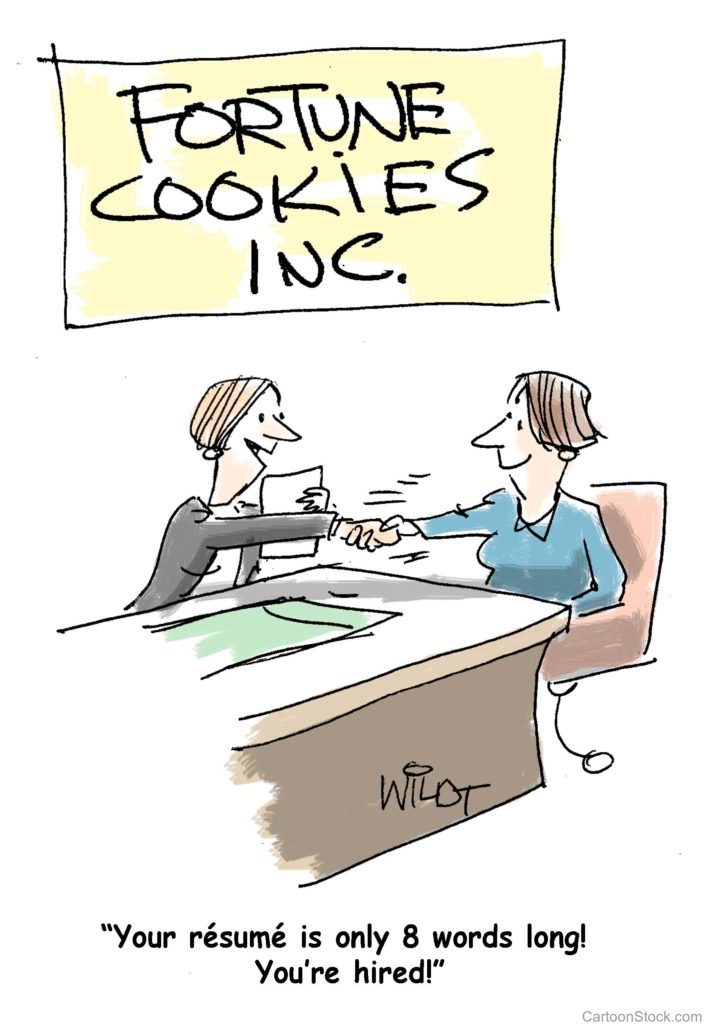
 In his book Presentation Zen, Garr Reynolds writes that one day, when teaching on the importance of eliminating unnecessary words when communicating, one of his students told a story that he had learned when growing up in India.
Here’s the story.
When Vijay opened his store, he put up a sign that said: “We Sell Fresh Fish Here” His father stopped by and said that the word “We” suggests an emphasis on the seller rather than the customer, and is really not needed. So the sign was changed to “Fresh Fish Sold Here”
His brother came by and suggested that the word “here” could be done away with—it was superfluous. Vijay agreed and changed the sign to “Fresh Fish Sold.”
Next, his sister came along and said the sign should just say “Fresh Fish.” Clearly, it is being sold; what else would you be doing?
Later, his neighbor stopped by to congratulate him. Then he realized that all passers-by could easily tell that the fish was fresh and that mentioning the word “fresh” actually made it sound defensive as though there was room for doubt about the freshness. So, he changed the sign to just: “Fish”
As Vijay was walking back to his shop after a break he noticed that one could identify the fish from its smell from far away, even at a distance from which one could barely read the sign. He knew there was no need for the word “Fish” so he took the sign down.
When writing or speaking, particularly in a business context, use as few words as necessary. Readers are impatient and they don’t want to work harder than necessary to get your message.
Here are examples of tightening your prose.
- “Learning is a process that requires…” becomes “Learning requires…”
- “They grew slack in their work for the seminar” becomes “They neglected the seminar.”
- “In close proximity to” becomes “near.”
- “In the majority of cases” becomes “usually.”
- “He stayed home due to the fact that he was ill” becomes “He stayed home because he was ill.”
- “He’ll return in the near future” becomes “He’ll return soon.”
- “The survivors were in a desperate condition” becomes “The survivors were desperate.”
- “The theater has seating accommodation for 600” becomes “The theater seats 600.”
How would you shorten these phrases?
- “The aircraft had a long-range capability.”
- “He agreed to play on an amateur basis.”
- “At the present time…”
- “Due to the fact that…”
If you want a severe challenge shortening a sentence, work on this: According to Wikipedia, the longest grammatically correct sentence is contained in Absalom, Absalom! by William Faulkner. The sentence is composed of 1,292 words (in the 1951 Random House version).
A lot can be said in few words. Albert Einstein’s doctoral dissertation was only 26 pages long. When he first submitted his dissertation, it was rejected for being too short. Einstein added a single sentence and sent it back, whereupon it was accepted.
Leaders, the next time you communicate to your constituency, trim down the number of words you use and your message will be easier to understand and better received.
If you want to read one book on improving your writing skills, I recommend William Zinsser’s On Writing Well, third edition.
[reminder]What are your thoughts about this essay?[/reminder]
 The hot-stove effect was first proffered by humorist Mark Twain.
 Time is a precious commodity. If traded on the commodities market, its value would be incalculable. But alas, time cannot be bought or sold. And while the length of our lives varies and is unpredictable, the number of hours we have in each day is fixed.
 You need margin to think. You need margin to play. You need margin to laugh. You need margin to dream. You need margin to have impromptu conversations. You need margin to seize unanticipated opportunities. Mark Batterson