Analyze the lens through which you see the world

Contact_Lenses_Care_tips

We must look at the lens through which we see the world, as well as at the world we see, because the lens itself shapes how we interpret the world. —Stephen Covey

For better and for worse, we all have what psychologists call “personal constructs” —frames of mind through which we see ourselves and others. I’ll adopt Covey’s metaphor and call those constructs “lenses.” Our lenses act as both frames and cages: they add focus and definition to our view of the world but they can also be inordinately rigid and restrictive.

Early in life, our lenses were crafted by our family of origin and our local environment. In essence, we inherited our first set of glasses.

For instance, I was born into an Anglo-Saxon, Protestant, conservative family who lived in the southwestern United States. I have a friend who was born in Mumbai into a Muslim family. Our lenses are different.

Our lenses influence major and minor areas of our lives:

      • Most of us worship the god of our fathers.
      • Most of us adopted the political ideology espoused by our family or local culture.
      • Items as trivial as the clothes we wear and our food preferences are influenced by our lenses.

Have you ever analyzed and critiqued the lenses through which you see the world? It is a healthy exercise. Doing so may,

      • Cause you to change
      • Solidify your perspective
      • Help you understand others
      • Encourage you to embrace diversity
      • Be an antidote for intellectual apathy

It is not for the faint of heart.

One of the best ways to expose our myopic view of life is to travel extensively. When we experience foreign cultures, we learn that our modus vivendi is just one of many and may not be the best.

Be skeptical; fine-tune your crap-detector.

To be a good writer you have to have a good, built-in, shock-proof bullshit detector.  Ernest Hemingway

Hemingway surmised that to be a good writer you had to be able to see through the folderol and not be duped by manipulation and deceit. If I may, I’ll rewrite his sentence to read, “To be a wise person you have to have a good, built-in, shock-proof crap-detector.” I have extended the application to all persons and chosen a slightly more socially acceptable term.

A crap detector is fueled by healthy skepticism. We all need a dose of skepticism because it protects against naiveté and being taken advantage of.

Be suspicious of advertising, PR, and marketing.

Most advertising is propaganda; it is self-serving manipulation. It is biased and often misleading. It blurs the distinction between perception and reality. When you hear a radio ad say “AAA Plumbing Company really loves its customers,” don’t be fooled. Of course they’re going to say that. Would you expect them to say “We really don’t care much about our customers; we just want your money”?

Fortunately, the Internet has given consumers new tools to see through the haze and shop smartly. Customer reviews can provide clear insights into products and services. So don’t fall prey to Madison Avenue.

Be distrustful whenever money is being exchanged.

Chances are good that the AC repairman is overcharging you. The suggested auto repairs your local Firestone store is recommending may be unnecessary. The medical treatments proposed by your doctor may or may not be necessary.

That’s why it’s prudent to always get multiple opinions and multiple bids. If you always get at least five bids on all products and services, you’ll typically save around 30%.

Be wary of political rhetoric.

I don’t listen to either Fox News or CNBC because neither reports unadulterated news; they give biased commentary on select topics. Interestingly, the BBC is a more impartial and reliable source for news about American politics and events. The Economist magazine, printed in Great Britain, is also a good source.

During political campaigns, it’s hard to trust what candidates are saying, because their messages are constantly being adjusted based on public opinion.

Be skeptical.

I’m not advocating philosophical skepticism, a branch of philosophy that questions the notion of absolute truth. I am promoting practical skepticism, a mindset that seeks to identify and debunk both intentional and unintentional falsehood.

Don’t be consumed by skepticism or allow it to morph into cynicism; it should not define your personality or outlook on life; not everyone is out to “get you.” You don’t want to be known as a negative, crotchety, and sullen cynic. But you do want to be wise, insightful and prudent.

Brian Dunning shares these interesting thoughts on skepticism:

“The true meaning of the word skepticism has nothing to do with doubt, disbelief, or negativity. Skepticism is the process of applying reason and critical thinking to determine validity. It’s the process of finding a supported conclusion, not the justification of a preconceived conclusion.

“The scientific method is central to skepticism. The scientific method requires evidence, preferably derived from validated testing. Anecdotal evidence and personal testimonies generally don’t meet the qualifications for scientific evidence, and thus won’t often be accepted by a responsible skeptic; which often explains why skeptics get such a bad rap for being negative or disbelieving people. They’re simply following the scientific method.” (Brian Dunning © 2015 skeptoid.com)

Embrace significant thoughts

5 thought-provoking cartoons about thoughts and prayers | The Week

Significant thoughts will change your life.

Call them what you want — wise sayings, proverbs, maxims, aphorisms, quotes — they are concisely written or spoken linguistic expressions that are especially memorable because of their meaning or structure. Distilled wisdom. Important thoughts reduced to a few choice words.

How do famous sayings come into existence? Who vets all the statements uttered by mankind and decides which ones are given the high honor of becoming timeless and often transcendent? Interestingly, there’s no selection committee and no official vote taken. A combination of time and human censorship filter and cull humanity’s thoughts, and the nuggets of truth have survived.

Here are some suggestions on how to benefit from significant thoughts.

Constantly search for them

In your reading and conversations, be on the lookout for thoughts that matter. Just this week, while reading a book, I discovered this Chinese proverb: That the birds of worry and care fly above your head, this you cannot change; but that they build nests in your hair, this you can prevent.

Write them down

If you don’t write it down, you’ll lose it. If necessary, write it on a scrap piece of paper until you can transfer it to your thought journal. Steven Covey says, “Writing bridges the conscious and subconscious mind. Writing is a psycho-neuromuscular activity that literally imprints the brain.”

Memorize them

This is the most important, but often neglected, step. When you memorize a statement, it finds a place in your mind and becomes available for reflection and application. Knowledge without memory is useless.

Share them

A.K. Chesterson said, “Thoughts disentangle themselves over the lips and through the fingertips.” Intentional dialogue is a terrific way to “untangle” significant thoughts. Simply introduce one of your thoughts into a conversation you’re having with friends. You might begin by saying, “I’ve been thinking about a phrase and would enjoy hearing your thoughts about it. Here it is…” The conversation will deepen your understanding of the thought and help solidify its place in your mind. It could also add value and meaning to what otherwise might be a frivolous conversation.

Apply them

One of the great moments of life happens when you personally experience, or see someone else experience, truth. For instance, one day I was coaching a young executive who was struggling with how to deal with a toxic team member who was  stirring up strife among his team. I shared with him an ancient proverb, “Remove the scoffer from your midst and strife will cease.” He immediately sensed that it was the right solution to the problem and soon started the process of dismissing the troublemaker. When the man was gone, strife ceased. I enjoyed watching a significant truth impact life.

Significant thoughts will change your life. Learn them and use them.

Click here to see 15 wise sayings that have changed my life.

Embrace robust dialogue in your organization and personal relationships

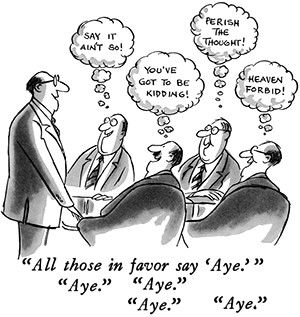
dialogue-cartoon-300x242

In 1997, managers at Samsung didn’t question a $13 billion investment that would take the company into the automobile industry because the idea’s champion, Samsung Chairman and CEO Kun-Hee Lee, was a forceful personality and a car buff. When Samsung Motors folded only a year into production, Lee wondered why no one had expressed reservations. (Teams That Click, HBSP, pg. 74)

Robust dialogue could have prevented Samsung’s debacle.

Simply stated, robust dialogue occurs in a group when everyone is encouraged, allowed, and even required to give their unfiltered input on issues. The value of robust dialogue is: Every idea or plan will be improved upon when submitted to the unfiltered wisdom and input of others.

Robust dialogue is not just the right thing to do; it is the best thing to do. It’s not just politically correct, it is practically helpful.

The prelude to robust dialogue may sound like this:

      • The boss says, “I’ve got an idea and I would really value everyone’s input. I want you to be totally honest.”
      • A team member says, “My division is thinking about offering a new service, but before we get very far down the road, I want to get your opinion on the project.”
      • A team member says, “I think we’re going in the wrong direction on this project.”

Bossidy and Charan teach that robust dialogue is based on openness, candor, and informality.

      • Openness—people are not trapped by preconceptions; they’re open-minded.
      • Candor—people speak candidly and express their real opinions. Truth is valued more than harmony.
      • Informality—informal dialogue invites questions, mental experimentation, and creative and critical thinking. Formality suppresses dialogue and leaves little room for debate.
        (Execution: The Discipline of Getting Things Done, pg. 102)

Robust dialogue will help maintain a transparent and healthy workplace. It’s amazing how often there’s an elephant in the room, but no one is willing to acknowledge it. Clarke and Crossland warn, “Every time your team avoids the critical ‘real issues,’ you lose. Every time the discussion outside the meeting room—physical or virtual—is dramatically different from the discussion inside the room, you lose.” (The Leader’s Voice, pg. 118)

Often, we avoid challenging dialogue because we value unanimity and harmony. But when we ignore the tough issues, we inadvertently dilute any sense of consensus; true alliance is achieved only when all the major issues have been identified and wrestled with. Consensus is good, unless it is achieved too easily, in which case it becomes suspect.

Robust dialogue is not only helpful in the workplace, it will also improve dialogue among family members and friends. See a previous post—Don’t go to Abilene—for an example of how robust dialogue might help family communications.