
In her must-read memoir, Educated, Tara Westover tells her story of being born into a family of survivalists in the mountains of Idaho. Her father was an extreme and controlling Mormon fundamentalist. He distrusted the medical establishment so Tara never saw a doctor or nurse. He distrusted government; Tara had no birth certificate. The family was isolated from educational opportunities. All seven siblings had been indoctrinated by their father’s crazy beliefs.
Tara was raised in an echo chamber.
The book recounts the fascinating journey of how Tara escaped her echo chamber, and eventually earned a PhD from Cambridge when she was 28 years old. [You really should read the book.]
So let’s talk about echo chambers.
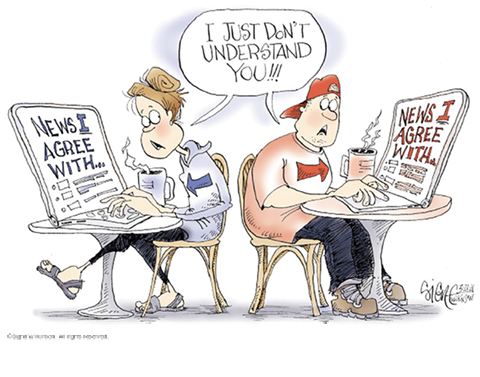
An echo chamber is an environment in which a person encounters only beliefs or opinions that coincide with their own, so that their existing views are reinforced and alternative ideas are ignored. They merely reinforce a set of beliefs that a particular culture deems sacred and unchallengeable. They lead to narrow-minded thinking and can increase social and political polarization and extremism.
Echo chambers can create misinformation and distort a person’s perspective, making it difficult to consider opposing viewpoints and discussing complicated topics.
Echo chambers proliferate in these areas:
-
-
- News outlets – In news media an echo chamber is an insulated environment in which listeners encounter beliefs that amplify or reinforce their preexisting beliefs. For instance: Fox News and MSNBC. These two cable channels have so much echo, I wouldn’t even call them news channels, they are political tools.
- Politics – in America, we have two pronounced political echo chambers: the Republican and Democratic parties. Consider the profound echo chamber that is present at their annual conventions.
- Social media – Facebook, Twitter, Tic-Toc can easily morph into echo chambers. Lisa MacLean, a psychiatrist with Henry Ford Health says, “Almost anyone can quickly find like-minded people and perspectives via social media. And with social media algorithms that ensure we only see media that fits our preferences, we find ourselves scrolling through comfortable, self-confirming feeds.”
- Religion – all major religions are echo chambers. Seldom will one religion encourage people to pursue exposure to other religions; most encourage proselytizing.
-
To avoid echo chambers and to mitigate their influence:
-
-
- Seek out people who have different perspectives than you.
- Consult multiple news sources to ensure you’re getting complete, objective information.
- Intentionally identify ways in which your echo chambers could be wrong.
- When you’re exposed to a new idea or thought, consider the source. Is it coming from an echo chamber?
- Practice constructive controversy. Use phrases such as, “I’d like to hear more about why you feel that way.” Or, “This is a safe space. We don’t all have to agree all of the time, I’d love to learn from you.” Or, “I respect that you feel that way; this is what I think about that.”
- Remember that just because you want something to be true doesn’t make it fact.
- Read books about experiences completely different from your own. The more we read about others’ experiences, the more empathetic and understanding we can become.
- Participate in Idea Labs – An Idea Lab is the opposite of an echo chamber. It is the intentional gathering of people who hold differing views. Participants see each other as experimenters and view their ideas as experiments. Idea Labs value independent thinking and diversity of viewpoints.
-
These questions will help you personalize this essay.
-
-
- Identify several echo chambers you live in.
- What are the advantages of echo chambers?
- What are the disadvantages of echo chambers?
- Have you ever left one echo chamber for another, or for a more moderate position?
- Is it possible to avoid being influenced by echo chambers?
- Consider this: what is the probability that your echo chambers are 100% correct? Are they 80% correct? Are you open to discovering areas in which your echo chambers are wrong?
-
What do you think?
I enjoyed the article. It made me think about the importance of spiritual discernment for the believer. The believer has the great benefit of having a relationship with God and the indwelling of the Holy Spirit, the unbeliever lacks this powerful advantage when it comes to discernment.
God has chosen us to live in this world and Christ has commissioned us to engage with it. Being able to do that effectively requires us to grow spiritually and become strong in discernment.
Thanks for sharing!
Thanks, Mike, for taking the time to respond. It’s good for us to receive a lot of input and then let the Holy Spirit sort it out. Take care, Don.
There are a lot of “chambers” to consider!
I’ve never thought about this way of evaluating others beliefs, thoughts, etc,.
As always, Don, you bring some outstanding thoughts to consider about life in general, but this is very helpful in today’s environment.
Thanks, Gail. I continually remind myself to seek alternate views. Thanks for responding to my posts. Don
Great perspective and one that I agree with. I am conservative and do listen to Fox News but also listen to NPR News and ABC News which are both considered liberal new media outlets. It does give me another perspective to consider with all that is happening in the world. I have to balance the two sides and then decide on what my personal opinion is.
It definately does not do any good to live in an echo chamber. I have some friends that have drifted so far to one side that I wish they would just listen to other opinions and move a little to the other side and have some balance.
Scott; good for you for pursuing different view points from various news outlets. I also like reading the BBC and The Economist – both produced in the U.K because they present an outsiders perspective. Take care, Don