
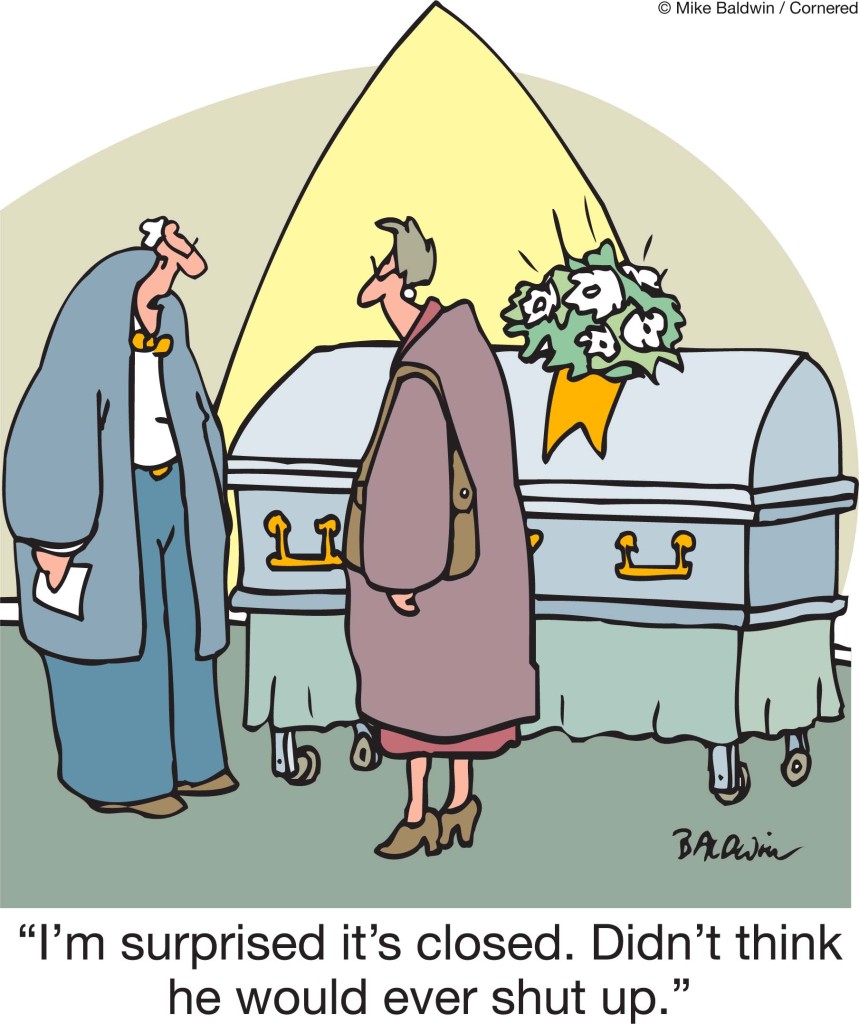
I’m continually befuddled and frustrated by one-sided conversations.
-
-
- I recently sat next to a person on a three-hour flight. I asked him about his career and family and he responded in detail. He never asked about mine.
- Mary and I had dinner with another couple. We initiated conversation about their world; they never asked about ours.
-
It seems to me that the focus of casual conversations should normally be evenly divided among participants. If there are four people present, each one should have about 25% of the time. Granted, if I had dinner with a famous person whom I admire, I might want the conversation to revolve around her; but otherwise, conversations should be distributed.
If you’re the victim of a lopsided conversation, take the initiative to direct the conversation. For instance, when in the midst of a one-sided-leaning conversation, sometimes I’ll pursue balance by answering the same questions I’ve asked. If I ask someone “tell me about your children,” I’ll then volunteer information about mine, even if it’s not requested. But it’s sad that I must do this.
If you’re the perpetuator of lopsided conversations, think about what’s driving the inequality and address the fundamental problem; it’s probably one of the “self” words: self-centeredness, self-reverence, selfishness. The solution to this social and relational faux pas is found is Philippians 2: “Do nothing out of selfish ambition or vain conceit. Rather, in humility value others above yourselves, not looking to your own interests but each of you to the interests of the others.” We should focus on others instead of ourselves.
We may be so self-absorbed that we truly aren’t interested in others, and that’s why we talk about ourselves exclusively. In which case we should discipline ourselves to behave right (ask about others) so that eventually our behavior will help us think right, that is, we’ll truly want to be interested in other people’s lives and want to prefer them. Every person has a story worth telling that we can benefit from hearing.
Let’s balance our conversations.
My daughter gayer and I have discussed this very topic. It happens to both of us more than we like to admit
Debra, thanks for responding. You are a wonderful conversationalists, always a good listener and contributor. Sadly, many people stay too focused on themselves and conversations get out of balance. Take care, Don
There are some easy devices to correct this situation. If someone is telling you about their children, it’s not difficult to give a comparative story about your own family. This morning I was telling a lady I didn’t know about my grandson’s experience of visiting the local grammar school for their open day and how he might be really disappointed if he didn’t pass the entrance exam.
She immediately replied with her children’s experiences of both the grammar and comprehensive secondary education system.
Stopping the other person’s flow by an exclamation such as that’s amazing and it reminds of ……………. tells the other person you have heard them and you would like to continue the conversation.
It is more difficult if you are talking to an isolated person who has no interests and family that show no interest in them. I visit a local care home and starting a conversation with someone who can’t go anywhere and every day is much the same, is not easy. Sometimes it can be done by finding common ground from their past experiences.
A more embarassing scenario is when someone’s politics or religion are diametrically opposed to your own and they are trying to impress upon you the rightness of their cause. Whether to get embroiled or to bring the conversation to an end, can be tricky.
Angela, you are so insightful. I should ask you to write some posts for me 🙂 It’s good to have some “pivot phrases” like you’ve suggested “that’s amazing; it reminds me of…”
Take care and keep your thoughts flowing my way. Don
A subject near and dear to my heart. We went to dinner as a foursome and the wife of one dominated the table with one of the men. Two were left out for 25 minutes. It can ruin friendships. I and the other “Left- Out” didn’t interrupt.
Kay, that’s a sad situation that often happens. Next time, try tactfully inserting yourself into the conversation, even if you have to talk over someone. People shouldn’t get away with dominating the conversation.
Take care,
Don
Hi Don, thanks for addressing this pervasive issue. I carry in my Bible an article written decades ago (I have a copy if you would like it) in USA Today about a reporter going to a party and engaging in a conversation with someone, asking them a thousand questions. However when he stopped asking questions, the other fellow was left speechless, not having anything to offer. I think today we have a lot of “talkers” and very few “conversationalists”. It is however refreshing when you meet a couple who have practiced being conversationalists, much like a tennis match with a lot of back and forth. Thanks again!
Steve, thanks for taking the time to respond.
I would enjoy reading that article.
I like the term conversationalists; it’s an important life-skill to develop.
Take care, Don.
Those comments ring so true! Some families, even, act this way—lip sided conversations.
Thanks, Gail, for affirming words. Don
I find the key for me is to ask the right questions, those that require historical information or further explanation. Try to eliminate questions that permit short yes/no responses. The other help is to listen intently. Many of us listen half-heartedly, thinking about our responses. A friend who was a pastor liked to start conversations in the philosophy section of bookstores, asking what they knew about a book or topic, which gave him an opportunity to ask in more detail about their belief and why. Led to some great conversations and an occasional invitation to his church. Conversation is fun. Thanks for suggesting this topic.
Ken
Hi Ken, thanks for sharing your thoughts. Having a set of pre-planned questions is very helpful to get conversations going. I sense you are a good conversationalists. Don