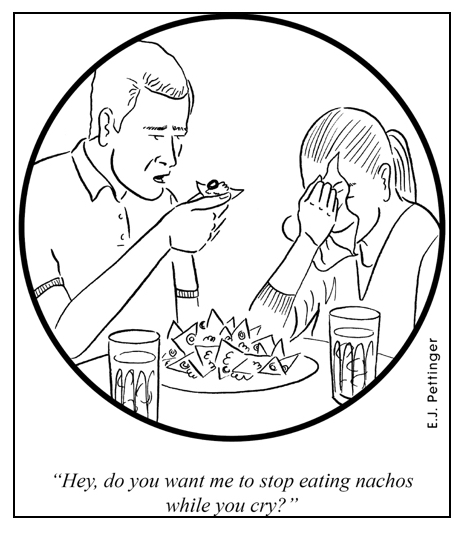

Wonderful things happen around a meal

The Spanish word – sobremesa – summarizes the message I want to convey in this post. It describes the time spent around the table after lunch or dinner, talking to the people you shared the meal with; time to digest and savor both food and friendship.

There is something profoundly satisfying about sharing a meal with other people. Eating together is one of the oldest and most fundamental unifying human experiences. It can simultaneously fulfill physical, emotional, and relational needs.

It will help establish and deepen friendships

If I share my food with you it’s either because I love you a lot, or because it fell on the floor and I don’t want it. (That’s a joke.) Seriously, I can’t think of another setting that’s better for solidifying friendships than gathering to eat. It slows down our pace, narrows our space, focuses our attention, and creates a relaxing ambience—all of which are beneficial for deepening friendships.

It’s good for business

Since humans first walked the earth, we’ve known that sharing a meal can be good for business. For instance, a recent study revealed that it doesn’t take much to get a doctor to prescribe a brandname medication—just a free meal. The study found that U.S. doctors who received a single free meal from a drug company were more likely to prescribe the drug than doctors who received no such meals. Meals paid for by drug companies cost less than $20 on average. [Even Cheap Meals Influence Doctors’ Drug Prescriptions, Study Suggests, Peter Loftus, WSJ, June 20, 2016].

I’ve never understood why some organizations are stingy with the amount of funds allocated for business meals. I once worked with a group of six senior executives at a $75 million dollar a year business. They were frustrated that the CEO, in order to save money, eliminated their budget for business meals, which saved the company a whopping $24k a year. I suspect that poor decision cost the company a lot of revenue.

It engenders good will

Treat someone to a $15 lunch and they’ll be your friend forever. Well, that’s an exaggeration; but it’s true that even a small amount of money and time will generate a lot of relational capital.

A weekly family meal can become a wonderful family tradition

I enjoy watching the sitcom, Bluebloods (on CBS). It follows the lives of three generations of New York City police officers. In most episodes, there’s a scene showing their weekly, Sunday afternoon family meal in which they gather around the dinner table to talk, argue, laugh, and pass the potatoes.

Every family would benefit from this tradition. My family enjoys weekend dinners together. We often share a meal together and then play games. Last week the game was, Get in groups of two, grab the dog and and teach it to dance. In a moment, choose a song you want to dance to and let it rip. We laughed so hard our sides ached.

I double-dog-dare you: initiate and host meals and enjoy the sobremesa.

[A Meal With Jesus – Discovering Grace, Community, and Mission around the Table is a terrific book by Tim Chester. The book reminds us that grace, mission, and community are never enacted best through programs and propaganda, but rather through the equality and acceptance experienced around a meal.]

Fallacy of the single cause

Zoom meeting for Travel with Friends trip to Iberia in August

“No one thing is the cause.” Tolstoy, War and Peace 

We live in a tumultuous world. Inflation is out of control, the war in Ukraine, worldwide political unrest, severe famine, extreme climate, and Kroger’s is out of my favorite sausage. Serious, complicated problems. And each problem affects the others.

There are no simple answers to these complicated problems because they are multifactorial. When seeking solutions, our tendency is to take a mental shortcut and look for one cause. But there is no single cause.

We have the same tendency when analyzing successes. It’s convenient and seemingly efficient to identify one reason why the United States is a strong country, or why Djokovic won the 2022 Wimbledon tennis tournament, but there are multiple reasons for these successes. There is no single cause.

Resist the temptation to over simplify. Take the time to identify the multiple factors something has happened.

      • Approach everything in life as multifactorial; everything is complicated and interconnected.
      • Most issues are progressing; factors are constantly changing.
      • Don’t be too confident or smug about your conclusions. At best you’re probably not seeing the entire story; at worst, you’re wrong.
      • Don’t discount other people’s thoughts and explanations. They too, have trouble seeing all the pieces, but they may see a piece that you don’t.

 Life is complicated; if we want to see it clearly, we need to embrace its complexity.

Travel with Friends Information Meeting on Zoom

Join me for a Zoom meeting on Thursday, March 19 from 7:00-8:00pm to visit about the upcoming TWF trip to Iberia in August.  If you want to join this Zoom meeting, email me at djmcminn@msn.com and I’ll send you a link. You can download Zoom for free. You can also participate via a conference call using your mobile phone.

We’ll discuss the itinerary, accommodations, and ports of call. The Q&A will answer all your questions.

Click below for a brochure about the trip.

Iberian-Peninsula-2026-Final Brochure

If you have any questions, email me at djmcminn@msn.com or call me at 214.783.4414

Adopt the Kaizen Strategy; pursue continuous improvement

Zoom meeting for Travel with Friends trip to Iberia in August


Fifty years ago, when I first started traveling internationally, all luggage was heavy and carried by hand. But in 1987, Bob Plaath, a Northwest Airlines pilot, invented the TravelPro, the first upright, two-wheeled rolling suitcase.

Then someone had the good idea of putting four wheels on luggage, making it easier to manipulate. Then manufacturers started using light weight materials. When empty, I can pick up my large suitcase with one finger.

What will be the next improvement in luggage? We don’t know, but it will happen, because the luggage industry will continue to improve its prosaic, simple product.

This continuous improvement is a good example of the Kaizen strategy.

Here’s the backstory.

 In 1950, 21 of Japan’s most important business leaders attended a dinner party in Tokyo. American statistician W. Edwards Deming was the keynote speaker. Deming said that the key to restoring Japan’s post-war economy was to pursue a simple strategy of continuous improvement of all products and services. Collectively, and without regulatory or legislative involvement, these leaders adopted Deming’s recommendations, which eventually led to a manufacturing and economic renaissance.

In two decades, Japanese products, which had been referred to as “Jap scrap,” became synonymous with “quality” and “super-engineering.” These quality improvement methods took Japan, within one generation, from a country that had been completely destroyed in 1945 to the number two economic power in the world. The Japanese called the process “kaizen,” which means “continuous betterment” or “continuous improvement.”

How can we benefit from this simple concept?  

Never be content with the way things are; continually strive to make things better. Adopt the mindset that everything is a work in progress and that incremental improvements can always be made. Continually ask, “How can this be improved?” 

Apply the Kaizen strategy to your personal life. Make it part of your modus operandi.

      • Embrace the thought that everything – all products and systems – can be improved. How you make your coffee in the morning (I discovered this week that I should grind my coffee beans coarse for use in a French press; I’ve been grinding them medium), your vacations, your library – everything can be improved. Even things that are mundane and simple – brushing your teeth – can be improved. 
      • Look for small, incremental changes, not just large major changes. 
      • Kaizen is continuous; don’t ever stop searching for ways to make something better.

Leaders, this is an important part of your job. Apply the Kaizen method to all processes, systems, services, events, and products. If your organization is large enough, create a position dedicated to Kaizen, someone who will constantly consider ways for every part of the organization to improve. 

Travel with Friends Information Meeting on Zoom

Join me for a Zoom meeting on Thursday, March 19 from 7:00-8:00pm to visit about the upcoming TWF trip to Iberia in August.  If you want to join this Zoom meeting, email me at djmcminn@msn.com and I’ll send you a link. You can download Zoom for free. You can also participate via a conference call using your mobile phone.

We’ll discuss the itinerary, accommodations, and ports of call. The Q&A will answer all your questions.

Click below for a brochure about the trip.

Iberian-Peninsula-2026-Final Brochure

If you have any questions, email me at djmcminn@msn.com or call me at 214.783.4414


I recommend you read this novel

Zoom Meeting for Travel With Friends trip to Iberia – March 19

For decades my favorite novel has been A Gentleman in Moscow by Amor Towles. Last month, I read Gilead by Marilynne Robinson and it immediately jumped to the top of my list.

I shouldn’t be surprised – Robinson wrote the book in 2004 and it won the prestigious Pulitzer Prize in 2005. President Obama awarded Robinson the National Humanities Medal in 2012  for her book.

The book is a long letter written by a dying, 76-year-old pastor to his 7-year-old son, hoping to codify and impart family history and wisdom before he dies. The narrative explores themes of faith, legacy, love, and morality.

The book gave expression to things I have sensed but never been able to clarify. It offered me thoughts that I have never had before. Often, I would reread a paragraph not because I didn’t understand it but because it was so beautiful and meaningful.

Here are a few nuggets.

    • “As I write I am aware that my memory has made much of very little.”
    • “It was like one of those dreams where you’re filled with some extravagant feeling you might never have in life, it doesn’t matter what it is, even guilt or dread, and you learn from it what an amazing instrument you are, so to speak, what a power you have to experience beyond anything you might ever actually need.”
    • “To be useful was the best thing the old men ever hoped for themselves, and to be aimless was their worst fear.”
    • “You’re just a nice-looking boy, a bit slight, well scrubbed and well mannered. All that is fine, but it’s your existence I love you for, mainly. Existence seems to me now the most remarkable thing that could ever be imagined.”

I do admit, that I might favor the book because I feel a kinship with the protagonist because I, too, am a pastor in my mid-70s and have a 2-year-old granddaughter living with us. I encourage you to read this book. I’m going to read it again.

Travel with Friends Information Meeting on Zoom

Join me for a Zoom meeting on Thursday, March 19 from 7:00-8:00pm to visit about the upcoming TWF trip to Iberia in August.  If you want to join this Zoom meeting, email me at djmcminn@msn.com and I’ll send you a link. You can download Zoom for free. You can also participate via a conference call using your mobile phone.

We’ll discuss the itinerary, accommodations, and ports of call. The Q&A will answer all your questions.

Click below for a brochure about the trip.

Iberian-Peninsula-2026-Final Brochure

If you have any questions, email me at djmcminn@msn.com or call me at 214.783.4414