
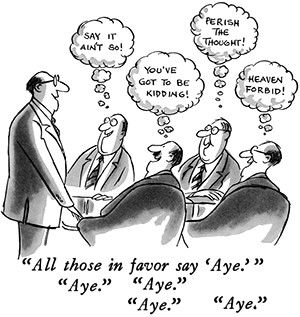
Critique and argument are keys to progress

How are things made better? What are the forces that can improve products, services, systems, and ideas? Critique and argument are indispensable.

Most of us are uncomfortable offering critique and/or arguing. It’s easy and pleasant to praise, encourage, and agree with others, but it’s difficult to critique and challenge. Similarly, we enjoy hearing words of commendation but we bristle at phrases that suggest we should do things differently. We like it when people agree with us and affirm our thoughts, but when they push back and disagree we are put-off.   

But critique and argument are indispensable for progress. The key thing to remember is that feedback is a gift so critique and argument should be received (even solicited) and considered positive. 

Critique

Verb—to evaluate (a theory or practice) in a detailed and analytical way

Noun—a detailed analysis and assessment of something

I avoid using the words criticize and criticism because they sound harsh and oppositional, whereas critique is a softer, more helpful approach. 

Everything—a Broadway show, a new model of car, software, a new hire, work done, performance—is improved by intentional and systematic critique from multiple sources. Feedback is a gift, and honest critical feedback is especially useful.

My friend Allen is professor of choral studies at a major university. When coaching his conducting students, in addition to praising them for what they are doing well, he must tell them what they are doing wrong. If he doesn’t, they will think all they are doing is satisfactory. It would be counterproductive for him to praise something that needs to change.

Argument

Noun: a reason or set of reasons given with the aim of persuading others that an action or idea is right or wrong

Verb (argue): to exchange or express diverging or opposing views

Argument helps us clarify our own thoughts and articulate them accurately, and we also consider the ideas of others in a respectful and critical manner. 

(Political debates are not good examples of the benefits of argument. When politicians “debate” all they’re basically saying is, “You’re wrong and I’m not.” There’s seldom any thoughtful discourse about real issues.)

Here’s a good article on the benefits of arguing.

In your family, at work, among friends…is it acceptable to critique one another? Is arguing allowed, even valued? The answer to both questions should be yes.

What do you think?

Be content. Why keep moving the goalpost?

I grew up in a 1,000-sq-ft. house. We had one car (that sometimes worked). My father barely finished high school. Our annual one-week vacation was to my uncle’s off-the-grid cabin in Arkansas. 

My life is vastly different now, exceeding my wildest childhood expectations. While the overall standard of living in America has steadily increased, my lifestyle has outpaced it. I am surprised at and grateful for the abundance I experience. 

While there’s nothing wrong with ambition and enjoying the fruits of good planning and hard work, there’s a danger in expectation-creep. At some point in life we need to hit the brakes on striving for upward mobility and instead be satisfied and grateful for our current status. If we don’t, we may be plagued by jealousy and discontent and become preoccupied in chasing an elusive, ever-moving target.

Micah 6:8 was my mother’s favorite verse and it has become one of mine: “He has shown you, O mortal, what is good. And what does the Lord require of you? To act justly and to love mercy and to walk humbly with your God” (NIV).

Solomon, a wise man from ancient times, summarized the good life by saying, “A person can do nothing better than to eat and drink and find satisfaction in their own toil. This too, I see, is from the hand of God” (Ecclesiastes 2:24). 

These verses commend a simple but focused life, marked by contentment and gratitude.

Understand the dangers of echo chambers

In her must-read memoir, Educated, Tara Westover tells her story of being born into a family of  survivalists in the mountains of Idaho. Her father was an extreme and controlling Mormon fundamentalist. He distrusted the medical establishment so Tara never saw a doctor or nurse. He distrusted government; Tara had no birth certificate. The family was isolated from educational opportunities. All seven siblings had been indoctrinated by their father’s crazy beliefs.

Tara was raised in an echo chamber.

The book recounts the fascinating journey of how Tara escaped her echo chamber, and eventually earned a PhD from Cambridge when she was 28 years old. [You really should read the book.]

So let’s talk about echo chambers.

An echo chamber is an environment in which a person encounters only beliefs or opinions that coincide with their own, so that their existing views are reinforced and alternative ideas are ignored. They merely reinforce a set of beliefs that a particular culture deems sacred and unchallengeable. They lead to narrow-minded thinking and can increase social and political polarization and extremism. 

Echo chambers can create misinformation and distort a person’s perspective, making it difficult to consider opposing viewpoints and discussing complicated topics.

Echo chambers proliferate in these areas:

      • News outlets – In news media an echo chamber is an insulated environment in which listeners encounter beliefs that amplify or reinforce their preexisting beliefs. For instance: Fox News and MSNBC. These two cable channels have so much echo, I wouldn’t even call them news channels, they are political tools.
      • Politics – in America, we have two pronounced political echo chambers: the Republican and Democratic parties. Consider the profound echo chamber that is present at their annual conventions.
      • Social media – Facebook, Twitter, Tic-Toc can easily morph into echo chambers. Lisa MacLean, a psychiatrist with Henry Ford Health says, “Almost anyone can quickly find like-minded people and perspectives via social media. And with social media algorithms that ensure we only see media that fits our preferences, we find ourselves scrolling through comfortable, self-confirming feeds.”
      • Religion – all major religions are echo chambers. Seldom will one religion encourage people to pursue exposure to other religions; most encourage proselytizing. 

To avoid echo chambers and to mitigate their influence: 

      • Seek out people who have different perspectives than you. 
      • Consult multiple news sources to ensure you’re getting complete, objective information.
      • Intentionally identify ways in which your echo chambers could be wrong.
      • When you’re exposed to a new idea or thought, consider the source. Is it coming from an echo chamber? 
      • Practice constructive controversy. Use phrases such as, “I’d like to hear more about why you feel that way.” Or, “This is a safe space. We don’t all have to agree all of the time, I’d love to learn from you.” Or, “I respect that you feel that way; this is what I think about that.”
      • Remember that just because you want something to be true doesn’t make it fact.
      • Read books about experiences completely different from your own. The more we read about others’ experiences, the more empathetic and understanding we can become.
      • Participate in Idea Labs – An Idea Lab is the opposite of an echo chamber. It is the intentional gathering of people who hold differing views. Participants see each other as experimenters and view their ideas as experiments. Idea Labs value independent thinking and diversity of viewpoints. 

These questions will help you personalize this essay.  

      1. Identify several echo chambers you live in.
      2. What are the advantages of echo chambers?
      3. What are the disadvantages of echo chambers?
      4. Have you ever left one echo chamber for another, or for a more moderate position?
      5. Is it possible to avoid being influenced by echo chambers?
      6. Consider this: what is the probability that your echo chambers are 100% correct? Are they 80% correct? Are you open to discovering areas in which your echo chambers are wrong? 

What do you think?

Travel with Friends information meeting on Zoom – February 12, 2026, 7:00pm

2026 trip to Netherlands/France/Portugal/Gibraltar/Spain – August 24-September 8

Thirteen years ago I started hosting an annual international trip for friends. I wanted to use my travel-knowledge to help others experience the wonders of travel. If you’ve not traveled much, it can be intimidating, mysterious, and confusing. My trips make travel accessible, safe, reasonable, and fun.

It’s also beneficial to travel with other people, because experiences are magnified when we share them with others. When you have an “ah-ha” moment–like seeing the beaches of Normandy– have it with others and it will be more deeply etched into your mind. Also, deep friendships are formed when you’re traveling with a group. Some of my best friends are those I have traveled with often.

On our 2026 trip, we’ll explore Iberia. The culture of the Iberian Peninsula is diverse and rich, shaped by a history of interaction between many civilizations including the indigenous Iberians, Celts, Romans, Visigoths, and Moors. We’ll visit five countries: Netherlands, France, Portugal, Spain, and Gibraltar (a British Overseas Territory).

Click below for a brochure about the trip.

Iberian-Peninsula-2026-Final Brochure

Travel with Friends Information Meeting on Zoom

Join me for a Zoom meeting on Thursday, February 12 from 7:00-8:00pm. If you want to join this Zoom meeting, email me at djmcminn@msn.com and I’ll send you a link. You can download Zoom for free. You can also participate via a conference call using your mobile phone.

We’ll discuss the itinerary, accommodations, and ports of call. The Q&A will answer all your questions.

If you have any questions, email me at djmcminn@msn.com or call me at 214.783.4414