
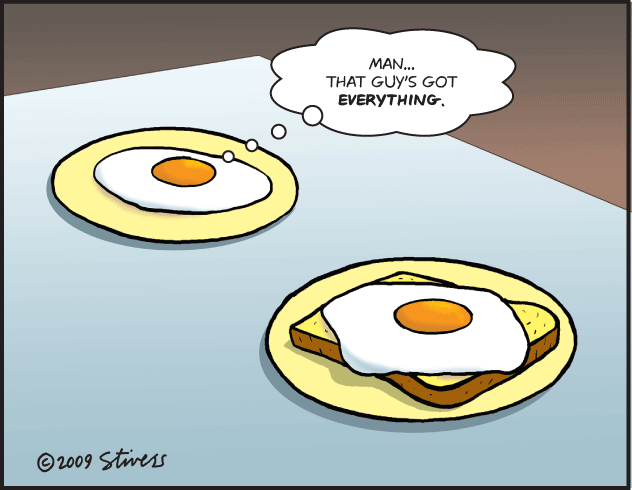
Envy is the most stupid of vices, for there is no single advantage to be gained from it. Balzac
I have many personal defects but there’s one vice I don’t struggle with: I don’t envy anyone.
As a young professional I struggled with envy, but perhaps age and maturity have dimmed that vice. Now, I can honestly say I am free from the debilitating and distracting feelings of envy. When someone wins, profits, or is acknowledged, I am happy for him or her.
Envy is a feeling of discontented or resentful longing aroused by someone else’s possessions, qualities, or luck. We resent the advantage enjoyed by another person and we often desire to possess the same advantage, coveting what someone else has.
Aristotle defined envy as pain at the sight of another’s good fortune, stirred by “those who have what we ought to have.” Bertrand Russell said that envy was one of the most potent causes of unhappiness. Not only is the envious person rendered unhappy by his or her envy, Russell explained, but that person may also wish to inflict misfortune on others, because of their advantage.
Most situations in life are not zero-sum scenarios (in order for someone to win, someone else must lose). To the contrary, there’s usually ample room for everyone to do well. So why be envious of others? And even in zero-sum situations (for instance, only one team can win the Super Bowl each year), why not graciously rejoice with those who come out on top? Is there any redemptive value in envy? I don’t think so. Someone else’s victory is not your defeat.
- Envy is spawned when we have a limited and myopic view of ourselves and the world: embrace the vastness of time and space and envy will dissipate.
- Envy is also cultivated by a self-centered, self-reverential worldview: prefer others and envy will lose its grip.
- A perpetual attitude of gratitude will help guard against envy: be grateful for what you have, not what you don’t have.
Envy is the art of counting another’s blessings instead of your own and it has no benefit.
[reminder]What are your thoughts about this essay?[/reminder]
[callout]I’m hosting a trip to Peru, May 6-15, 2020. It will be limited to 50 travelers. Here’s the brochure. On Saturday, May 18, 2019 from 4:00-5:00, I’m hosting a free information meeting for anyone who wants more details about the trip. It will be held in the DFW metroplex and broadcast live on Facebook for those who live elsewhere. If you want to attend, email me at djmcminn@msn.com or respond to this blot post. [/callout]
 On May 6, 1954, middle-distance athlete Roger Bannister ran the first sub-four-minute mile in recorded history. The 25-year-old native of Harrow on the Hill, England, completed the distance in 3:59.4 at Oxford. At the end of the year, Bannister retired from running to pursue his medical studies. He later became a neurologist.
 A draft horse is a large, muscular animal that, prior to the industrial age, was used for pulling big loads. One draft horse can pull an 8,000-pound load. Two draft horses randomly linked together can pull a 24,000-pound load. If the two horses have been trained to work together they can pull 32,000 pounds
 Both my daughters studied violin in high school. They excelled, taking lessons at SMU and playing in the Dallas Youth Symphony. For one concert, they played in the Meyerson Concert Hall (one of the best musical venues in the world). Mary and I were seated in the middle of the hall, our attention focused on Lauren and Sarah.