
Five frogs sat on a lily pad; one decided to get off. Now, how many frogs are on the lily pad?
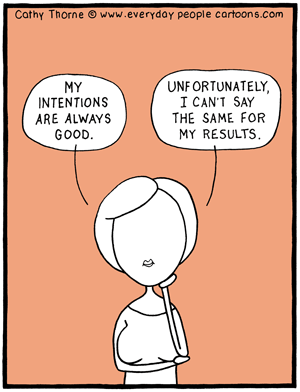
We mustn’t confuse intentions, resolutions, plans, and decisions with action.
-
-
- Intending to do something doesn’t change anything.
- Planning to do something is not synonymous with doing it.
- Deciding to do something is not the same as doing it.
- Action is the sine qua non of change and the precursor to progress.
-
Granted, planning and action are mutually dependent. Action without planning can be ineffective and inefficient. Abraham Lincoln said, “Give me six hours to chop down a tree and I will spend the first four sharpening the axe.” Good planning increases the effectiveness of action. But planning without action is just wishful thinking.
Business consultant Peter Drucker said, “Ideas don’t move mountains; bulldozers move mountains, but ideas show where the bulldozers have to go to work.” Until you hear the rumble of the bulldozer and feel the resistance of the dirt, you haven’t bridged the gap between planning and action.
Planning, by itself, can be deceptively easy—even enjoyable. Jerry Brown, former governor of California, said, “The reason everybody likes planning is that nobody has to do anything.” All great ideas must inevitably evolve into work.
After you have planned, it’s helpful to immediately do something toward reaching the goal; this kickstarts momentum. Indira Gandhi, former prime minister of India, said, “Have a bias towards action – let’s see something happen now. You can break a big plan into small steps and take the first step right away.” All projects can be broken down into small, actionable tasks. Identify one and get started.
I ask again: Five frogs sat on a lily pad; one decided to get off. Now, how many frogs are on the lily pad?
There’s still five frogs, expressing an intention doesn’t mean that the intention is executed. The steps to get it achieved, called planning are after the intention. Only after all the steps of the planning come to fruition then the existing condition changes to four frogs, otherwise it will continue to be five frogs.
Thanks, Alfredo, for taking the time to write. I do think that planning can precede expressing intentions, but it’s not a substitute for action.
One upset the balance and none were left OR depends on how many other frogs were also on the same lily pad???
The lesson in this post is that intentions don’t imply action or results. One frog decided to get off, but did it?
Thanks for responding. Don
This was timely Don! My teenage grandson had not firmed up his plans for the day and need to be at my house by approximately 4.30 pm. My parting words, in the morning, were make sure you communicate your plans to me.
By 2.00 pm I had not heard a word so I rang him. He had obviously forgotten our conversation and I had to remind him that I needed to know how and when he would arrive at my house. It turns out that he hadn’t communicated his plans to his mum and stepdad.
When he arrived, I gave him your article to read which I think hit the spot!
Nice…
As stated the five are on the lily pad and one decide to get off. This is only an intention, however doesn’t mean to put it into action and as one popular saying “hell is full of intentions” however the achievement of the intention is not planned neither carried out so there still remains the five frogs.
Another example would be in engineering we set the steps with anticipation of how to get an engineering product to perform according to what is expected to contribute to the system that is part of. Establish with clarity how the surrounding environment has to be controlled to get good results.
Thanks, Alfredo, for taking the time to respond to my post. Even in your engineering example, steps of anticipation (plans) are not an assurance that they will be performed. Thanks for our friendship. Don
Great thoughts, and so true! This is true in every area of life!
Thank you Don!
Thanks, Gail.