
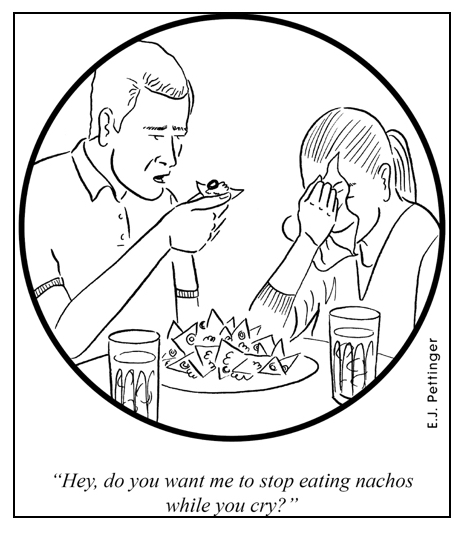
Empathy and sympathy are valuable life skills.
They are important to our own mental and emotional health, and they are essential to developing deep, meaningful relationships with other people.
For the first 40 years of my life, I didn’t really understand what these words meant—or, more importantly, how to practice them. I’m still learning.
Empathy and sympathy are related, but they are different.
Sympathy is feeling concern for another person because of what they are experiencing. Someone tells you, “I lost my job today,” and you respond, “I’m so sorry. That must be really difficult.”
Empathy takes us a step further. It means entering, as best we can, into another person’s experience and feeling something of what they are feeling: “I’m so sorry. I can imagine how painful and frightening this must be. I hurt because you’re hurting.”
I’ve written about these ideas in previous posts. Here, I want to focus on two practical ways we can develop empathy:spending time with people who have special needs and their families, and reading good novels.
Spend time with people who have special needs
Being involved with people who have special needs—and with their families—reminds us of a fundamental truth: every human being is created in the image of God (Imago Dei). That means every person has inherent dignity, value, and purpose.
As we get to know these individuals—not simply as “people with special needs,” but as friends—we begin to see their unique personalities, hopes, joys, frustrations, and struggles. We become more aware of the challenges they and their families face every day.
And as we enter their world, even in a small way, empathy begins to grow.
Read good novels
Good novels can do something remarkable: they allow us to enter the lives of people who are very different from us.
In one novel, we may follow a character, a family, or a group of friends for years—even generations—experiencing their moments of joy, love, disappointment, grief, and despair. We watch their lives unfold and begin to understand why they think and feel the way they do.
The fact that the story is fictional doesn’t diminish its value. We can still identify with the characters because, beneath our differences, human beings share many of the same fundamental emotions and longings.
But not all novels are equally helpful for developing empathy. Look for books that emphasize character development and the inner lives of the people in the story. Many action novels, detective stories, and science-fiction books I’ve read are entertaining, but they didn’t necessarily take me deeply into the emotional lives of their characters.
If you want to experiment with my premise, I recommend The Covenant of Water by Abraham Verghese.
It’s a big gulp—715 pages, or about 31 hours in the audiobook—but it delivers.
While reading it, I often wept. Sometimes I would simply close the book and think about what I had just experienced.
It was a wonderful investment of time. I thoroughly enjoyed the book, but more importantly, it helped me become a better person.
It fine-tuned my sense of empathy.
And perhaps that’s one of the great gifts of a good novel: for a few hundred pages, it invites us to leave our own little world and enter someone else’s.
If we do that often enough, we may become better at doing the same thing in real life.
Don,
Your discussion bout “good” novels is great! I watched the play “Les Miserables” – I was so moved that I bought the book and have read it – I’m on my third time through it. It makes me cry every time. The book dealing significantly with good and evil, seeing that evil is not always t it appears to be. You cannot read this book without having deep empathy for Jean Valjean. This is the novel that helped me understand your post.
Of course the Bible, while not a novel, should help develop empathy that changes lives eternally!!
I really have enjoyed your posts in the past. I actually attended Stonebriar Community Church when I lived in the Tribute. The music your present has moved me deeply. I only wish that I would have had the opportunity to sing in the choir while I was there. The come in each Sunday in anticipation of the prelude – brass ensemble, string quartet, pipe organ, or full orchestra was something I’ve never experienced before or since.
God bless your for your service to Him – for God’s glory and our good!
Mark Raper
Mark, thanks so much for taking the time to respond. I enjoy watching the movie of Les Miserables (the old version).
I wish we had met years ago when you were at Stonebriar. It is a great church. Take care. Don
That would be a great requirement for any one, but especially medical students of all kinds. I worked in the medical field over 52 years. Some techs were as cold as ice. Some were actually ill tempered toward patients that had logistical impairments. Well said.
Gail, good observation. My son-in-law is CMO of a large hospital. He says that for most patients the difference between a “good” physician and one that is lacking is the absence of presence of people skills. Don