
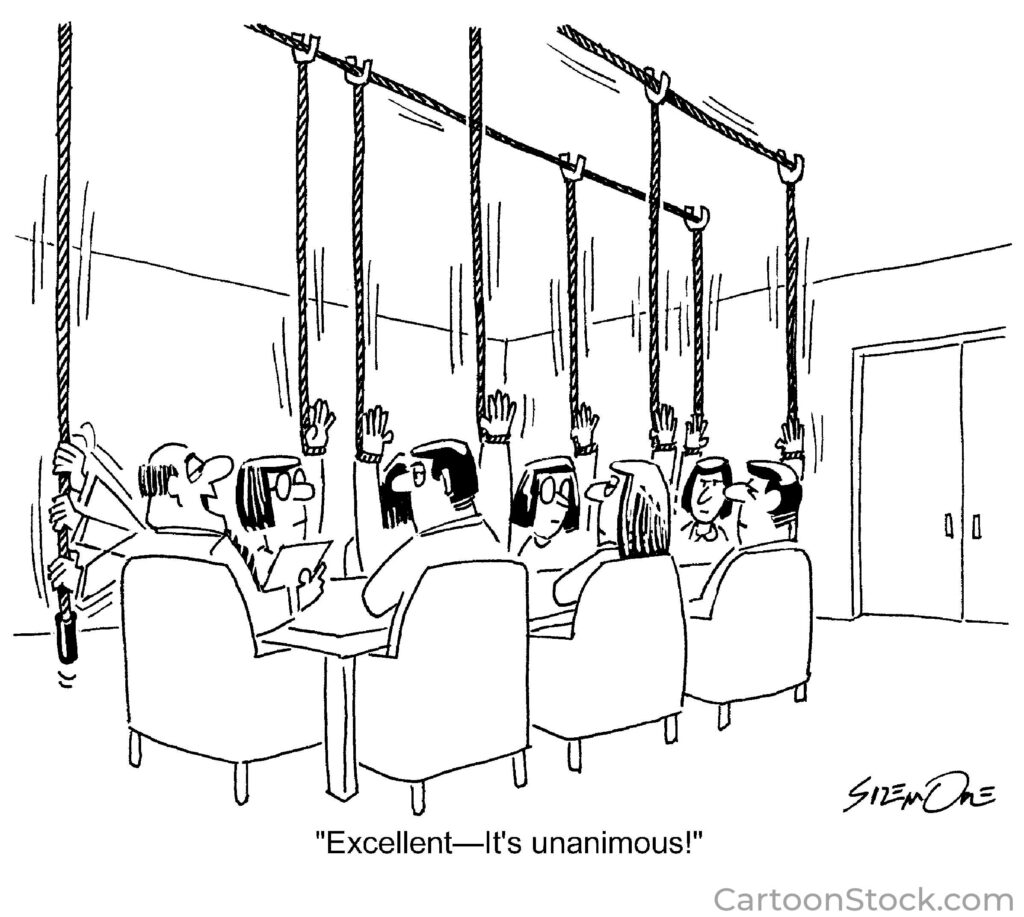
Years ago I served a church that was searching for a senior pastor. Eleven people were on the search committee. In their first meeting, someone must have suggested that their final decision be unanimous—to call a new pastor, all eleven members must be in agreement. [A scripture verse might have been used to support this position, “That they will all be one, just as you, Father, are in me and I am in you” (John 17:21).]
After months of prayer, and multiple interviews, ten members of the committee were convinced that one particular candidate was the right person for the job. One person dissented. Because of their commitment to act unanimously, the will of one person prevailed over the preferences of ten people. The minority ruled.
This predicament is called minority rule and it should be avoided.
Every team or committee should be composed of vigorous-thinking individuals who are striving to make good decisions. Everyone should have a voice and a vote, but one person should not be given the power to overrule the opinion of others. It might be reasonable to say that 70% of the group must be in agreement, but to set the bar at 100% is naive, unnecessary, and can be detrimental. There’s nothing wrong with a split decision.
A split decision may even indicate that the right decision was made because it implies that critical dialogue was pursued and multiple perspectives were considered. While a unanimous decision could indicate that the decision is simple and the best answer was obvious, or that everyone genuinely agrees, it can also indicate that the group is not taking the decision seriously, all variables have not been explored, or that some members may be intimidated by the arguments of those who are more demonstrative and verbal.
What do you think?
Serving in a public office makes this even more critical. As our school board makes decisions for the District, we all must express our opinions even if we disagree with one another. The dialogue must remain respectful and helpful, avoiding personal attacks or adjacent comments that aren’t helpful, but unanimous decisions are nearly impossible. This is okay.
Moving that into a Church environment is tricky, but required. As a pastor, I appreciate the Elder who pushes back, thoughtfully asks tough questions, and challenges me to think. I need that as a leader.
Bob, it’s nice to hear from you. I have good memories of our times together.
You’re right, robust dialogue is a valuable tool for good conversation and making good decisions. “All of us are smarter than one of us.”
I believe we live in a time where the wrong thing to do and damage people. Is the new norm. When I was younger and people act the same way. It was corrected right then and there. Now it it no one business if you do stand up for God and the things that are right in the world. You are now told you are wrong. Yes, everyone should have an opinion. But those who are wiser and know the candidate should speak up. The right people are not being trusted and elected anymore. Which is a shame goodness should be rewarded also hard working people. Someone who serves others as best they can even when they are hurting. When it is inconvenient because they love the good people they serve and help.
While it is important that decisions being made must be agreed upon by majority without necessarily paying a blind eye to the minority or dissenting views, we must choose progress and not stagnation. Minority positions can also mean well for the entire group. On the other hand the minority might simply want to subbotage noble causes. We need to avoid giving veto powers to idmndividual.
Felix, thanks for taking the time to write. I agree with your good thoughts. Don
Didn’t Solomon suggest to divide the baby? Became obvious who was the mother. Unfortunately, equally divided isn’t always the right solution. I’ve been an expert witness over the years and in non- jury trials, usually financial or seeking damages. too many judges add up the request from plaintiffs and defendants, and divide by two…usually the wrong decision but the easy way out. I’ve seen a few senior pastor searches, one involving my friend. A search committee of five or seven seems to be reasonable, assuming it represents a cross section of the membership. Question? Should the senior pastor being replaced be included on the committee?
Hi Ken, sorry for my tardy response. Normally, I think the outgoing pastor should not be involved in choosing their successor. In what area were you an expert witness? Don
This is a very good example of where a unanimous decision is not the appropriate voting mechanism. As the recruitment committee was so large it made the probability of a unanimous decision almost impossible.
It would have been worth the eleven listening to the reservations of the one dissenting member in case that member saw or knew something about the candidate that the others did not. Once his/her reservations were considered but found to be without foundation, it would have seemed right to vote again to see if the dissenter would now vote in favour.
We have different percentages for votes in our church and where the vote is very close, the actual percentage is revealed in case members wish to change their vote on a second ballot. This worked well on a particularly thorny policy decision.
Amen !!!
Every government should be composed of vigorous-thinking individuals who are striving to make good decisions. No one branch, say, the executive, should userp the power to intimidate the rest, the judiciary and judicial. No one should have to live in a country in which Donald Trump is the President.
I think you are right about the 100% time….i have never seen any committee agreeing 100%. Church boards, public school boards, PTA boards, city councils—-I don’t think I’ve known of any. I believe that the majority be the “voice”. If something should develop that the minority vote was in favor of, then that’s when that particular group needs to re-evaluate the issue. Like you said. Split decisions indicate some people were critiquing the issue properly.
Thanks, Gail, for taking the time to think with me.