
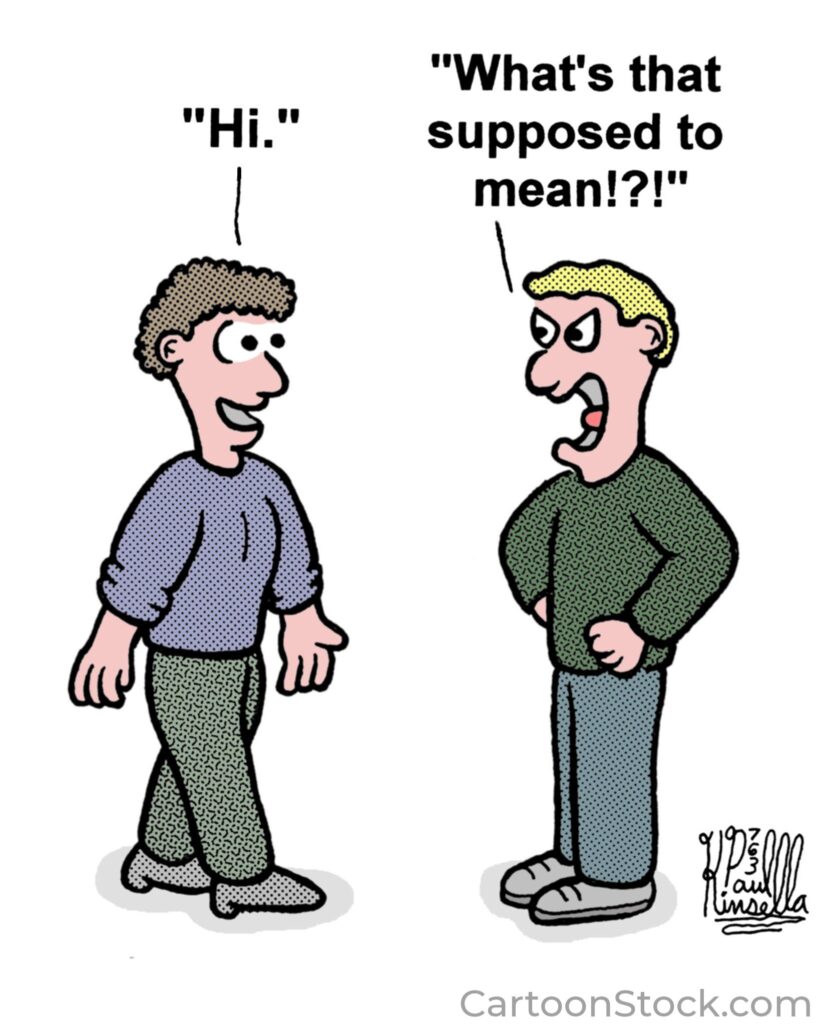
Writer Sarah Lyall tells of a man’s outburst in a supermarket when he couldn’t get a certain type of cheese—a blue cheese called Cambozola. The man was obnoxious and belligerent. A store employee observed, “I don’t think this is about the cheese.”
We’re all guilty of this unfair, unproductive, immature, hurtful, and wrong behavior. We’re angry about X, but we express our anger to people that are unrelated to X. We’re frustrated at work and when we get home we yell at our spouse. We’re frustrated at home and take it out on our coworkers. We’re angry about something but we give grief to the deli worker at the grocery store.
In these cases, it’s not about the cheese. It’s about unresolved and misplaced anger.
Sometimes anger resolves itself. If I’m upset at a minor issue—the lawn mower won’t start—in time the anger will dissipate. But if the anger is deep seated, I need to talk it out with a counselor or a friend.
If we’re angry because we think someone has done us wrong, we should properly express our anger to the person or persons we think offended us. In a controlled manner, share your perspective and be open to hear “the other side of the story.” Approach these conversations carefully because your anger may be unjustified or overblown.
Or, we can simply choose to drop it.
If we do take out our frustration on an innocent bystander, we need to apologize. Do that often enough and it will help change your behavior. Don’t ever apologize for your misbehavior and people will begin to avoid you.
One of the hardest things to do in life—requiring extreme self-awareness and self-control—is to sense when you’re about to take your frustration out on the innocent, and not do so. Better yet, we can even anticipate acting badly and make a decision to preempt bad behavior. For instance, having had a bad day at work, while driving home I should make a note-to-self—“I’ve had a hard day.”—and remind myself to not take it out on my family.
I love that phrase—It’s not about the cheese. I’m going to suggest to my family that we use it with one another as a verbal cue when we think one of us is venting on an innocent bystander.
I like that “quote” about the frustration reminder regarding the cheese! I think I’ll copy that with my family! THANKS!
It’s a great phrase.
Been there, done that! Thanks for sharing the cause of the problem so simply and appropriately. And how to manage it so doesn’t continue. Your subjects, your observations and resolutions are expressed as a good friend would. How well observed and well resolved. Thank you for being non-judgmental by carefully handling this subject as a wise and caring friend.
Gaylon, thanks for kind and encouraging words. I struggle with this issue with my immediate family. I want to get better about that. Take care, Don