
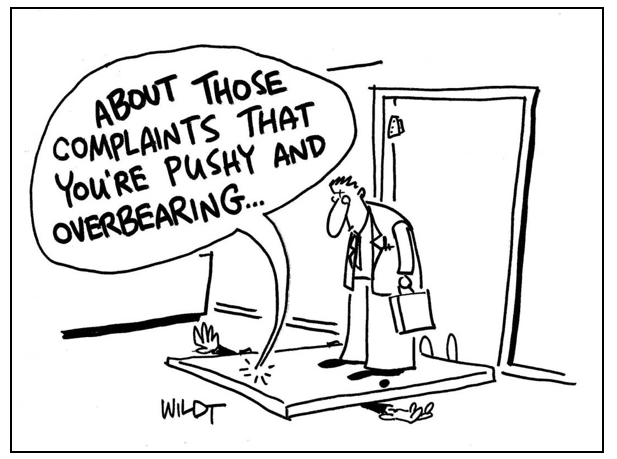
I once had an employee who had the audacity to declare, “I know I have a short fuse and a bad temper, but that’s just who I am. People who work with me just need to deal with it.” I informed him that his inordinate temper would not be tolerated because it is an area that he has control over and needs to change.
I have a friend who is always late. She’ll probably be late to her own funeral. When I questioned her about her tardiness, she replied, “Yeah, I’ve always struggled with being on time. My mother was that way; I must have gotten it from her.” Her attitude is unacceptable. It’s rude to be tardy and everyone can learn to be punctual.
Don’t ever make excuses for character flaws and bad behavior because they are not part of your inalterable essence—you can, and should, change.
The serenity prayer says it quite eloquently:
Give me the serenity to accept the things I cannot change,
The courage to change the things I can,
And the wisdom to know the difference.
-
- You can’t change your height but you can change your weight.
- You can’t change your basic personality (and you don’t need to) but you can choose to be punctual, positive, kind, discreet, fair, etc.
- You can’t change who your parents are but you can choose your friends.
- You can’t change the weather but you do have sovereign control over your attitude.
Take responsibility for your attitude and behavior. Don’t minimize, ignore, or make excuses for personal deficiencies. If you talk too much, talk less. If you talk too loudly, speak more softly. If you are pessimistic, choose to be optimistic.
Marshall Goldsmith, an executive coach, said, “Over time, it is easy for each of us to cross the line and begin to make a virtue of our flaws—simply because the flaws constitute what we think of as ‘me.’ This misguided loyalty to our true natures—this excessive need to be me—is one of the toughest obstacles to making positive long-term change in our behavior.”
I wonder if this attitude of “this is just who I am” comes out of the idea that we should give unconditional love and accept a person “warts and all”. Sadly, that creates a world where there are people who carry the burdens of others who are quite capable of carrying their own burdens. Is it one of the reasons so many marriages fail? One of the spouses works their socks off while the other watches the TV? This may work in the first flush of romance but eventually “the worm turns”.
Many of these flaws show disrespect for others. However, if we do not discipline our children when they behave in this way, how will they learn how to live in the “big wide world”. In the UK, parents like to medicalise all sorts of unacceptable behaviour in their children.
Some of the phrases my parents used have disappeared from common parlance. Examples: “The world does not owe you a living”. “The world does not revolve around you.”
In parts of the world where people have suffered poverty and deprivation an organisation called Tearfund has been challenging the behaviours that have been at the heart of the problem and prosperity and happiness have resulted. You might find it useful to have a look at their work.
Angela, as always, you bring balance to my thoughts. I have no patience with dead-beat husbands. I’m also trying to balance how I influence my children and grandchildren: accept them for who they are but encourage them to be better. Have a good holiday. Don
We have a need for discipline, from childhood to our second childhood. I am included.
Ken, thanks for responding to my post. We are all a work in progress. The key is to keep at it. Thanks, Don.
So, so TRUE!
Thank you so much for this topic. I have read it many times now because I have been guilty of believing the lie that this is just who I am. My mother reinforced this notion as I was growing up and I took it on as truth. I am praying for God’s help.
Cindy, I’m glad you’re starting to filter through all the statements that people have said about you and finding the truth. Take care, Don.