
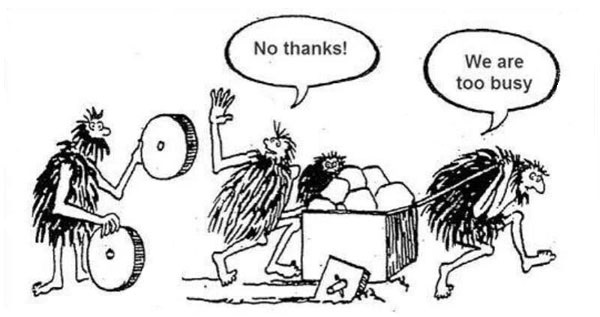
Fifty years ago, when I first started traveling internationally, all luggage was heavy and carried by hand. But in 1987, Bob Plaath, a Northwest Airlines pilot, invented the TravelPro, the first upright, two-wheeled rolling suitcase.
Then someone had the good idea of putting four wheels on luggage, making it easier to manipulate. Then manufacturers started using light weight materials. When empty, I can pick up my large suitcase with one finger.
What will be the next improvement in luggage? We don’t know, but it will happen, because the luggage industry will continue to improve its prosaic, simple product.
This continuous improvement is a good example of the Kaizen strategy.
Here’s the backstory.
In 1950, 21 of Japan’s most important business leaders attended a dinner party in Tokyo. American statistician W. Edwards Deming was the keynote speaker. Deming said that the key to restoring Japan’s post-war economy was to pursue a simple strategy of continuous improvement of all products and services. Collectively, and without regulatory or legislative involvement, these leaders adopted Deming’s recommendations, which eventually led to a manufacturing and economic renaissance.
In two decades, Japanese products, which had been referred to as “Jap scrap,” became synonymous with “quality” and “super-engineering.” These quality improvement methods took Japan, within one generation, from a country that had been completely destroyed in 1945 to the number two economic power in the world. The Japanese called the process “kaizen,” which means “continuous betterment” or “continuous improvement.”
How can we benefit from this simple concept?
Never be content with the way things are; continually strive to make things better. Adopt the mindset that everything is a work in progress and that incremental improvements can always be made. Continually ask, “How can this be improved?”
Apply the Kaizen strategy to your personal life. Make it part of your modus operandi.
-
-
- Embrace the thought that everything – all products and systems – can be improved. How you make your coffee in the morning (I discovered this week that I should grind my coffee beans coarse for use in a French press; I’ve been grinding them medium), your vacations, your library – everything can be improved. Even things that are mundane and simple – brushing your teeth – can be improved.
- Look for small, incremental changes, not just large major changes.
- Kaizen is continuous; don’t ever stop searching for ways to make something better.
-
Leaders, this is an important part of your job. Apply the Kaizen method to all processes, systems, services, events, and products. If your organization is large enough, create a position dedicated to Kaizen, someone who will constantly consider ways for every part of the organization to improve.
Travel with Friends Information Meeting on Zoom
Join me for a Zoom meeting on Thursday, March 19 from 7:00-8:00pm to visit about the upcoming TWF trip to Iberia in August. If you want to join this Zoom meeting, email me at djmcminn@msn.com and I’ll send you a link. You can download Zoom for free. You can also participate via a conference call using your mobile phone.
We’ll discuss the itinerary, accommodations, and ports of call. The Q&A will answer all your questions.
Click below for a brochure about the trip.
Iberian-Peninsula-2026-Final Brochure
If you have any questions, email me at djmcminn@msn.com or call me at 214.783.4414
When I first became a Chief Information Officer, I thought that getting the corporation to a high level was my goal — “don’t fix what ain’t broken”. However, over the next few years, I realized I had to drive innovation or the business would fall behind our competitors. Constant improvement became the goal. As a result, we were annually selected as one of the top information technology organizations in the nation. And our company also moved ahead.
Thanks, John, for sharing your thoughts and your experience with being a CIO. I recently heard: “If it ain’t broken, improve it.” Thanks for being my friend. Don
That is a great example of Kaizen in action. The luggage story is a perfect illustration of how meaningful change often comes through a series of small, thoughtful improvements rather than one massive breakthrough.
In our work, we see the same pattern with the companies that achieve the most success. Our top clients are the ones who are constantly investing in their businesses and looking for ways to improve their operations. They rarely view their systems or processes as “finished.” Instead, they continually ask how things can be done a little better, a little faster, or a little more effectively.
Over time, those incremental improvements compound, and the results become significant. It is very much the Kaizen mindset applied to modern business operations.
Thanks for sharing this perspective.
Thanks, Scott, for taking the time to share your thoughts. They are always beneficial. Relative to the Kaizen Strategy, I recently heard a complimentary thought: “If it ain’t broke, make it better.” Take care, Don.
Always looking to improve on even the most mundane tasks— great observation! Thank you Don!
Thanks, Gail, for responding. You appear to be a fully-alive person who loves to grow and learn. Don