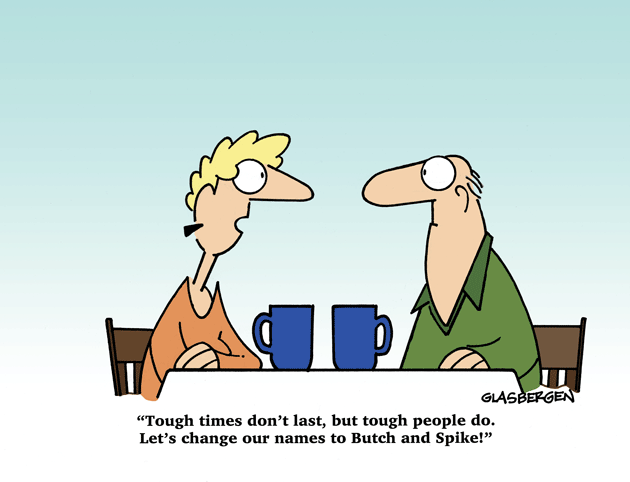
Don’t make excuses for character flaws and bad behavior, thinking “that’s just who I am.”

excuses3.001

I once had an employee who had the audacity to declare, “I know I have a short fuse and a bad temper, but that’s just who I am. People who work with me just need to deal with it.” I informed him that his inordinate temper would not be tolerated because it is an area that he has control over and needs to change.

I have a friend who is always late. She’ll probably be late to her own funeral. When I questioned her about her tardiness, she replied, “Yeah, I’ve always struggled with being on time. My mother was that way; I must have gotten it from her.” Her attitude is unacceptable. It’s rude to be tardy and everyone can learn to be punctual.

Don’t ever make excuses for character flaws and bad behavior because they are not part of your inalterable essence—you can, and should, change.

The serenity prayer says it quite eloquently:

Give me the serenity to accept the things I cannot change,
The courage to change the things I can,
And the wisdom to know the difference.

    • You can’t change your height but you can change your weight.
    • You can’t change your basic personality (and you don’t need to) but you can choose to be punctual, positive, kind, discreet, fair, etc.
    • You can’t change who your parents are but you can choose your friends.
    • You can’t change the weather but you do have sovereign control over your attitude.

Take responsibility for your attitude and behavior. Don’t minimize, ignore, or make excuses for personal deficiencies. If you talk too much, talk less. If you talk too loudly, speak more softly. If you are pessimistic, choose to be optimistic.

Marshall Goldsmith, an executive coach, said, “Over time, it is easy for each of us to cross the line and begin to make a virtue of our flaws—simply because the flaws constitute what we think of as ‘me.’ This misguided loyalty to our true natures—this excessive need to be me—is one of the toughest obstacles to making positive long-term change in our behavior.”

Leaders; lead.

Lead2.001When in a position of leadership, lead.

My impatience peaks when I’m at a stoplight and there are several cars in front of me and the light turns green and the person at the front of the line doesn’t move. Arghhh… I usually honk.

I start an imaginary conversation with this person: “Ma’am, sir, do you not realize that because you are at the front of the line, no one can move until you move? Therefore you must be doubly attentive. You’re wasting everyone’s time by not acting responsibly and quickly. Move it…”

My contrived conversation is therapeutic; I feel better after venting my frustration, if only to myself. But this reoccurring scenario also reminds me of a basic tenant of leadership: when in a position of leadership—lead.

Leaders, your team and organization are waiting for you to act. You’re at the front of the line. They won’t move until you do. If you’re passive, they will be, too.

When do leaders move and where do they go? Leaders move because of and toward, vision.

The sine qua non of leadership is having fresh vision. Vision is a picture of the future that is better than the present that produces passion. If you’re in a position of leadership and you don’t have credible vision you may be managing but you’re not leading. Good leaders are obsessed with developing good vision because that’s what “turns the light green” and dictates where you “drive.”

Leaders also take initiative; they have an agenda; they want to get from point A to point B; they are dissatisfied with the status quo.

Vision + initiative = progress.

Warren Bennis said, “Action without vision is stumbling in the dark and vision without action is poverty-stricken poetry.” Leaders need both vision (where we are going) and initiative (let’s start moving in that direction).

The analogy I’ve created is not exact, but it will work. The next time you’re stopped at a streetlight and the light turns green and the person in front doesn’t move, let it be a reminder of the fact that leaders must lead.

When you’re at the front of the line and the light turns green—go.
When you’re in a position of leadership—lead.

When you offend someone, confess and ask forgiveness

confession

Relational offenses are inevitable. It’s not a matter of if you’re going to offend someone, it’s just a matter of when and how seriously. The best and perhaps the only way to make things right is to confess your offense and ask forgiveness.

Her are some characteristics of a good confession.

1. The scope of a confession should equal the scope of the offense.

You should confess to everyone who was privy to a particular offense. If three people heard you yell at your spouse, you need to confess to four people.

If you just think poorly about someone but don’t actually say anything, you don’t need to confess to that person; in fact, doing so might create unnecessary hurt and confusion.

2. Confessions are most effective when we take initiative to confess without having to be confronted.

Can you sense the difference in these two scenarios?

Joan: Hey Bob, got a minute?
Bob: Sure, what’s up?
Joan: When we were having lunch yesterday you said something that really offended me.
Bob: Oh yeah? What did I say?
Joan: It was the comment about my work on the Meyers project.
Bob: Oh, that bothered you? Well, okay, perhaps it did come across a bit tacky. Sorry about that.

Bob: Hi Joan, got a minute?
Joan: Sure, what’s up?
Bob: Yesterday, when we had lunch together, I made a tacky comment about your work on the Meyers project. It was wrong of me to say what I did. Would you forgive me?

In the first scenario, Joan confronts a clueless Bob. In the second scenario Bob initiates the conversation. There’s a huge difference.

3. Be specific; name the offense.

Hurts don’t come in generalities; they are specific. So our confession must be specific. Can you sense the difference between these two statements?

“Honey, if I’ve ever done anything to offend you, would you forgive me?”

“Honey, I realize that I have had a critical spirit toward you. Last night I criticized you about the hotel arrangements you made for our vacation. I should have been grateful that you took the initiative to plan such a nice trip.”

A good confession will mention a specific wrong.

4. Properly address the emotional hurt that your offense has caused.

Offenses are not only technically wrong, they hurt the offended person. So when we offend someone, we should confess our wrong and address the hurt that we caused. For instance, if I yell at my children, I have not only wronged them, I have hurt them. I must deal with both the technical aspect of being wrong and also the emotional dimension. That’s why a good confession will often involve empathetic words such as, “I’m so sorry that I hurt you by yelling.”

You may even want to ask the offended person to elaborate on how your offense has affected him or her.

5. In your confession, use the phrase “I was wrong”; not just, “I’m sorry.”

Just saying “I’m sorry” can compromise and even neutralize a confession. For instance:

    • “I’m sorry what I said offended you (but it wouldn’t have offended you if you weren’t so hypersensitive).”
    • “I’m sorry you feel neglected (but after all, you are overly dependent).”
    • “I’m sorry you were upset by my teasing you at the party (even though everyone else thought my story was hilarious).”

Use the phrase “I was wrong” because it admits personal responsibility for the offense and conveys a sense of seriousness.

6. Don’t dilute the confession.

When confessing an offense, don’t include any statements that would dilute the confession. Do not:

    • Minimize the offense – “Yeah, I got angry and yelled at you, but that’s not the main issue.”
    • Rationalize/justify – “The reason I yelled was…”
    • Blame others – “I wouldn’t have become angry if you hadn’t…”
    • Offer a trite confession – “Okay, okay; I’m sorry.”
    • Ignore the offense – “Let’s talk about something else.”

7. Ask forgiveness.

For a confession to be complete, we must ask to be forgiven. The best way to do this is simply to say, “Will you forgive me?” Hopefully, the offended person will forgive you.

If he or she does not, and you have genuinely and properly confessed, you have done all that you can and should do; it is now the other person’s decision whether or not to forgive you, but regardless of his or her response, you should be free from guilt.

Run at your problems

Zoom meeting November 20 – 2026 trip to Iberia

run-at-problems-001All leaders can become good problem-solvers. To do so, they must do four things: Anticipate problems before they occur; maintain a positive attitude while they occur; use all their resources to solve them as quickly as possible so they cease to occur; learn from them so the same problems do not occur again. —John Maxwell, Developing the Leaders Around You

The biblical story of David and Goliath pits a giant against a young man in an epic confrontation between good and evil. My favorite part of the story is when the duel begins: “Then it happened when the Philistine rose and came and drew near to meet David, that David ran quickly toward the battle line to meet the Philistine.”

David ran at Goliath.

It wasn’t a display of youthful hubris or stupidity; it was considered aggression and confident courage. David’s pugnacity must have thrown Goliath off balance. The giant was used to frightened, tepid foes, but here was a young man running towards him.

In your personal and professional affairs, run at your problems.

The alternate approach is procrastination or avoidance. Most problems don’t resolve themselves; they must be aggressively and tenaciously pursued.

Identify at least two problems in your business or personal life that need to be addressed. Schedule a time to deal with each one.

Travel with Friends 2026 trip to the Iberian Peninsula

Click below for a brochure about the trip.

Iberian-Peninsula-2026-Final Brochure

Travel with Friends Information Meeting

On Zoom – Join me for a Zoom meeting on Thursday, November 20, 2025 from 7:00-8:00pm to visit about the trip. If you want to join this Zoom meeting, email me at djmcminn@msn.com and I’ll send you a link. You can download Zoom for free. You can also participate via a conference call using your mobile phone.

At both meetings, we’ll discuss the itinerary, accommodations, and ports of call. The Q&A will answer all your questions.

If you have any questions, email me at djmcminn@msn.com or call me at 214.783.4414